
Pura vida
The things that happen

I accept that I can no longer jump off my right foot … in Mexico, one of the men of the arena, a great master of the lasso, assured me that this was part of life, this was pura vida [‘pure life’]. Euklides was his name. He shook me by the hand the first time I was thrown [by a bull] and bleeding out of my mouth because I’d almost bitten my tongue off when I hit the deck. His hand felt like a vice. What he meant wasn’t the purity of life, as with the early saints, but the sheer, brute, unpredictable, overwhelming presence of life. (Werner Herzog, Every Man for Himself and God Against All)1
You never know what worse luck your bad luck has saved you from. (Cormac McCarthy, No Country for Old Men)
One of my neighbours is a retired forester who has a lot of interesting old wounds, especially in his legs, which are probably one tenth surgical metal. He makes his injuries into stories, not complaints. These are full of drama, surprises, humour, indignities and pain. You do things; you get smashed up; your body gets further and further away from its factory settings.
If you do physical work for long enough, if you split enough logs, something’s likely to get you in some more or less serious way. Outside that, the strain can start to nag away at your joints and in time you’ll have a dodgy shoulder or bad knees or arthritic hands or whatever. If you’re lucky these won’t stop you from earning a living in your chosen way or getting a decent amount of enjoyment and satisfaction from life.2
I think about this when they talk about raising the retirement age. If you sit at a desk five days a week, possibly working from home since 2020, this might seem regrettable but basically alright. If you’re a roofer, not so much.3
But even sedentary types, even writers and other slack-limbed, pale-faced losers, experience pura vida. It may not be woven so closely into the fabric of their everyday lives, but there it is.
A friend and some-time colleague at an academic publisher shattered his ankle while helping someone move house and then nearly lost his foot from an infected hospital implant. The hair on his ankle still grows upward after a skin graft he had following reconstruction surgery.
My wife lost the hearing in her right ear and some of her sense of balance after an operation to remove a chance-in-a-hundred-thousand brain tumour.4 When the surgeons finished her ear was sealed like an empty tomb.
Neither my friend nor my wife dwell on their losses and I remembered this when a fluoroquinolone antibiotic called ciprofloxacin damaged my joints and tendons to the extent that I couldn’t stand up for more than a couple of minutes at a time.5 Although I can now walk many miles on a good day they’ll never be the same again.
There were other things I remembered.
I remembered friends diagnosed with rare blood disorders and cancers, one of whom died a few hours after I visited him for the last time; my grandfather diagnosed with MS in his early forties with his children still at school; two friends diagnosed with MS in their twenties; the boy at school who’d been born with a defective heart and alternated between crutches and a wheelchair. While I was laid up, a friend, someone whose presence I can always imagine without trying, died without any sort of warning from a blood clot.
I also remembered something said during a cross-cultural communication course at an old job: that many of our offshore colleagues lived very different lives from us, less secure, less predictable, more exposed to the workings of blind chance in everyday life. Similarly, previous generations living in Western Europe and North America were less shielded from the buffetings of raw life than we are.6 Being struck down by some damn thing, often something petty, was just what happened, and is still just what happens in many places.7
Another thing I remembered was Eric Hoffer’s8 short book, The True Believer, where he talks at one point about “People who see their lives as irremediably spoiled”. They are one of the character types prone to fanaticism.
In a minor key, you can see this in the Hollywood stereotypes of the brilliant high school athlete who is now an ageing loser brooding over old glories after something, perhaps an injury, wrecked the prospect of a career, and the disappointed prom queen living through her mercilessly driven daughter.9 The latter is a good example of one of Hoffer’s observations:
Their innermost craving is for a new life—a rebirth—or, failing this, a chance to acquire new elements of pride, conscience, hope, a sense of purpose and worth by an identification with a holy cause.
The holy cause could be your child getting the honours and glory you failed to attain; it could be international communism or mass murder of the people behind the imperfection of the world; or it could be something personal and potentially benign and selfless, as when bereaved parents dedicate themselves to campaigning to protect others from similar affliction.10
Some people who have suffered try to ‘raise awareness’ to spare others from being struck down by whatever hit them. It can give meaning to suffering.
A related effect, a sign that an experience hasn’t been fully processed, is when people make their affliction part of their identity, see the world through its prism, and in a strange way almost live for it, like those whose lives are given meaning by having an enemy.11
You can also medicalise your life; becoming a sort of passenger riding along the tracks of the various systems and procedures, viewing yourself as a case, as a collection of symptoms and treatments, an entity defined by tests and measurements and metrics, and perhaps not much else.12
I didn’t want to be one of those “People who see their lives as irremediably spoiled”, not even one of the altruistic ones. What had happened to me was just part of life, it was pura vida.
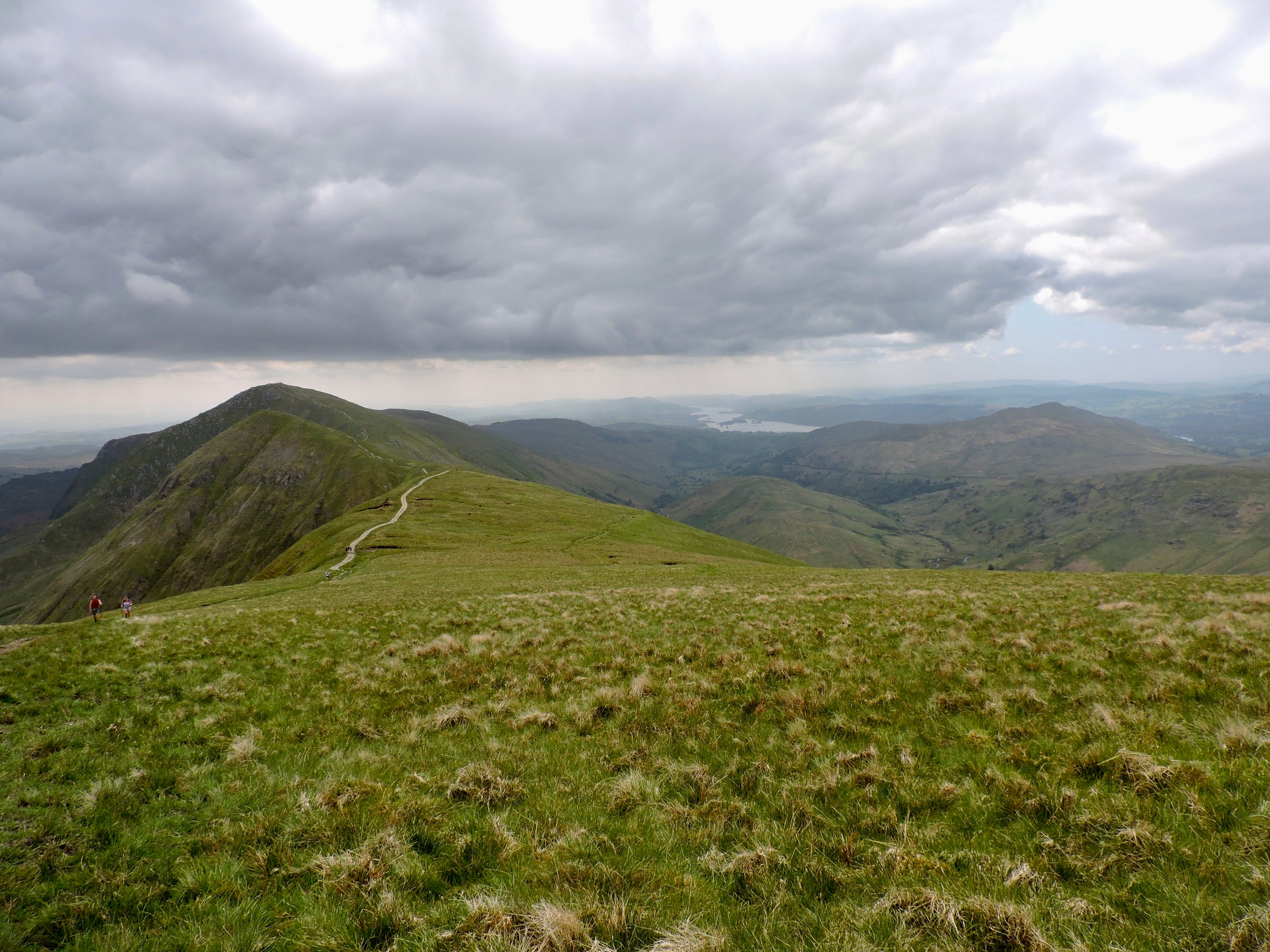
This isn’t fatalism or indifference; I’ve worked hard to recover. When I was laid up I plotted my way through the walks I’d do in the future. Two years after I’d spent ten days just getting the toes on my frozen left foot to move, I walked the Kentmere Horseshoe, the first big one on the list. I carried my young son in a backpack on many shorter walks. Although things have deteriorated since then—relapses, slippages and nagging problems are common—I’m still hoping to work back to ultimately be able to walk the Dales Way (Ilkley–Windermere); the Via degli Dei (the Way of the Gods, Bologna–Florence following the ancient path); and English pilgrimages such as Winchester–Canterbury and Canterbury–Rome. I’d like to walk at least some of these with my children as they grow up.
It’s a matter of perspective. Spoiled lifers tend to compartmentalise their lives: your real life was all before it happened and what follows is imposture, fake, unworthy, unjust; it’s a tragic variant of “My real weight and body shape are what they were when I was 17”. In Great Expectations, after being abandoned on her wedding day, Miss Havisham continues to wear her wedding dress until she dies, as the celebration feast decays on the still set table, and she schemes for vicarious revenge; there is no continuum in her life, only before and after. The (un)holy cause of her ‘second’ life, her vengeance, could be seen as an attempt to impose meaning on her affliction.
For me, I’d rather absorb the experience, compost it13 and wait for whatever meaning there is to emerge later. You might not know for a long time and even then your view is likely to change. Maybe it’s illusory in any case. But whatever has happened to me is life, and part of my life, and becomes part of me, whether that’s a simple physical scar; moving like a ninety year old some mornings; or something more intangible. If in the end I can’t walk the Via degli Dei with my family, the sadness will also become part of me, as it should, because that is also life, pura vida.
You play whatever hand you are dealt with as much courage and skill as you can, knowing that many are likely to have worse, and some never had much in the way of cards to start with. As time passes, physically you’ll start playing weaker hands anyway—even without the ciprofloxacin I am not the fifteen year old who could jump over a pub table from a standing start—though perhaps your gameplay will improve. But, whatever cards you began with, however good your play, however wealthy you or your country are, and however skilled your physicians, one day you’ll lose everything you have in this world; whether dramatically, like lightning out of a clear sky, or slowly and inexorably, like water eroding things made of earth.
This thing all things devours;
Birds, beasts, trees, flowers;
Gnaws iron, bites steel;
Grinds hard stones to meal;
Slays king, ruins town,
And beats mountain down. (Riddle from The Hobbit. The thing is time.)
Paul Fishman (Skelsmergh, December 2025)
Earlier in Herzog’s memoir he relates why he can’t jump off his right foot. As a young man (I think in his early twenties) he had a running game with some young children (twins) in a family he was staying with where they tried to ambush and trick each other in a friendly way.
One day I spotted them plotting an ambush for me behind the door that led down to the garage, and I crept into the top-floor bathroom intending to jump all the way down and, coming through the garage, attack them from behind. My own preferred weapon was shaving foam. It had been snowing, but there was only an inch or so of loose snow, which I thought was enough padding for my leap. I landed on the spiral concrete staircase that led down into the garage. My ankle made a penetrating sound I can hear to this day; it was like a wet branch snapping when you step on it. The fracture was so complicated that I was operated on and encased in a plaster cast up to my hip.
Side note: my forester friend’s worst injury occurred not during work but after a night’s drinking in circumstances I won’t talk about.
A word also for e.g. cleaners, some factory and warehouse workers, etc; a painter and decorator friend became a chimney sweep after his shoulder no longer allowed him to raise his arm. Farmers are an exception, rarely seeming to fully retire, though the older ones often have interesting collections of injuries and maladies.
A vestibular schwannoma, aka an acoustic neuroma. It required a 13.5 hour operation, followed by another 4 hour one the following day to fix some of the damage. The tumour was touching her cerebellum and she had to recover from stroke-like problems in addition to everything else.
As it turned out, this wasn’t the recommended antibiotic for what the GP thought I had; he hadn’t followed the recommended investigative path; restrictions had been placed on use of fluoroquinolones and patients were supposed to be given information about them; I didn’t have what he thought I had and didn’t require antibiotics of any kind.
I acknowledge that without access to antibiotics, the chance of me dying young, before the ciprofloxacin wrecked my limbs, would’ve been much greater.
Appropriately, Hoffer was a longshoreman who was obliged to retire at 65 because of the physical demands of his occupation.
There used to be a British literary tradition about the most brilliant, precocious, self-assured, universally accomplished boy/young man at e.g. Eton and Oxford, who everyone expects to flourish but somehow fails of his promise, never develops as an adult; this continued at least as late as Anthony Powell’s Dance to the Music of Time sequence well into the twentieth century. It has been suggested that Al Gore was groomed to be president from birth by his disappointed senator father.
When misdirected this can obviously also be harmful, however well intended.
There are forums, support groups and ‘survivor’ websites for floxies (people affected by fluoroquinolone antibiotics). Some of these share useful information, if used carefully and sceptically, and there are well-intentioned people involved, but they are dangerous places to spend time in.
An extreme example of analysis of and resistance to this is the work and thought of Ivan Ilich (see here for his obituary in The Lancet), notably in his book, Medical Nemesis, and in his life, where he refused to consult a physician for a tumour on his cheek, which first caused him agonies and then killed him suddenly, at his desk. See e.g. here (British Journal of General Practice) for a quick summary.
Some things compost more easily than others, and mine is studded with poorly broken down acorns, pine cones and wine corks.
This is my favorite post of all the ones you’ve ever done. There are so many good quotes and so much to think about. Truly brilliant. I love the pic of Grandpa.
“You never know what worse luck your bad luck has saved you from.”