
Strangers met on the way
And things heard on the road

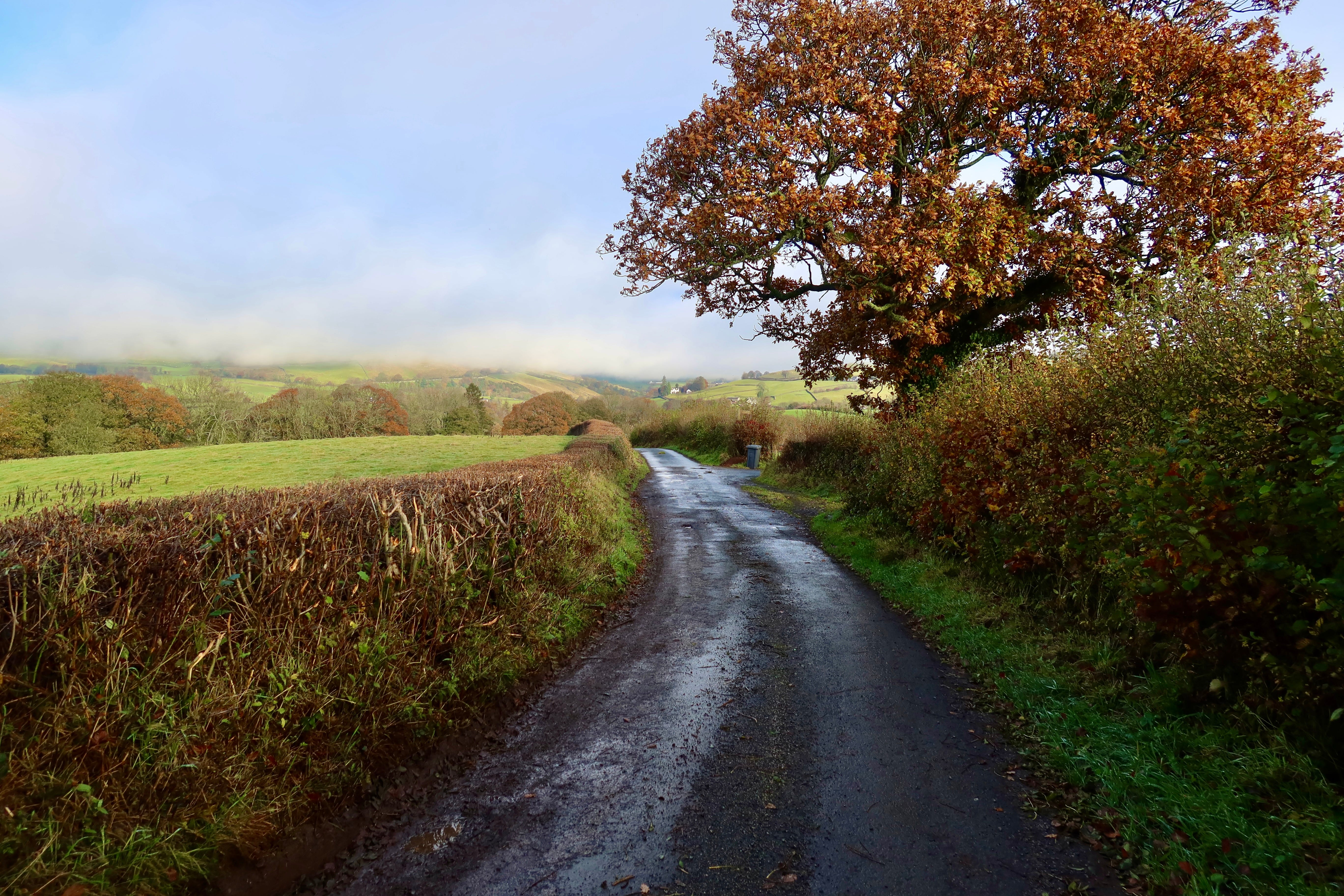
For around two years, from him being just about still a baby to no longer being a toddler, I carried my son on walks several times a week, sometimes every day. We went out in all seasons and all weather. For some of the time it was because my wife was working on a contract and I was looking after him, but it also just became what we did together.
I’d put him in his backpack and walk miles and miles on the lanes, through the fields and over the fells; we must’ve walked hundreds of miles together and we met many people on the way, sometimes the same people regularly. Most were old enough to be retired because who else would be wandering about during weekdays? The men were much more likely to make a quip, usually revolving around the desirability of being carried on my back (“Room for another up there?” etc). One man in the nearest village made the same two jokes every time. Some just said something like, “Good lad,” meaning that I was doing a good job, and getting the boy off to sleep, which they mostly assumed was the purpose of our endless walking. (By being friendly passers-by would sometimes wake him up after miles of treading had got him off to sleep; especially when it was a large group of hikers, chattering like jackdaws.) Both men and women talked about how good the modern backpacks are and wished that they’d had them. The women were more likely to ask questions, sometimes quite detailed, and they’d often enquire into our home affairs and about my wife, etc. They were also more likely to make comments or offer advice. Some of the advice was excellent and carefully modulated; some was obviously the result of some specific trauma they’d experienced at a similar time. There were a few who just liked laying down the law. One pair of middle-aged women who were walking the Dales Way from Ilkley to Windermere stopped to talk for almost an hour, speaking to me very earnestly about what I should do when our second child was born, for both the children and their mother. They were nice and made a lot of sense and I remember them fondly. Much of what they said concerned the delicate psychology of a larger family unit.
There was another overlapping spell of making a lot of chance acquaintances around two and a half years ago when my son was still only one, my wife was pregnant with our second child and my father was—so all medical professionals agreed—likely to die at any time. (Happily he’s still alive.) We’re stuck out in the country without a car and I was taking taxis all the time, between our house and my parents’, between hospitals, etc, and some of the journeys were quite long. I had many conversations with taxi drivers, a few of whom I came to know quite well.
Once I was called by a doctor at Royal Lancaster Infirmary at 3 a.m. and told to come in immediately if I wanted to say goodbye to my father, who probably wouldn’t last the night. The hospital was twenty miles away. I phoned Blue Star Taxis, ‘my’ firm, and was told there was nothing available, but when I explained the situation the night dispatcher (also a driver) got someone to work extra time to cover his jobs and came to get me himself. It could’ve been an awkward, silent journey, but we talked quite naturally about our families, my wife’s pregnancy, the ebb and flow of life. On the return journey a Romanian driver from a Lancaster firm told me about his brother’s last illness and how he’d handled it—badly by his own account—and questioned whether the fall of Nicolae Ceaușescu was all it seemed.1 We shook hands when he dropped me off.
One regular driver would begin a journey by saying, “Now then, what have you got to tell me today?”, and then listen politely before telling a series of stories about unusual, often comically bad, experiences he’d had. Once, when I was being picked up from my parents’, my mother told him I’d be right out, I was just getting my baggage. When I emerged he was incredulous—Call that baggage? One bag?—and then mentioned this with renewed disbelief every time he picked me up.
Some of the drivers (mostly South Asian) came up from Lancashire every day to work here. The younger ones often liked to show their friendliness by offering advice, and they’d find a topic they knew about and then tell me about it. I was instructed in the best way to get a driving licence quickly; how to buy a second-hand car; the wisdom and manners of the road; etc. There can be something soothing and almost hypnotic about listening to someone speak whereof they know, or from evident good will, and I liked this.
In turn, some would ask me detailed, at times touchingly naive, questions about Cumbria and the Lake District or say how much they liked it—most though not all said that the people were polite and friendly, as well as the countryside being beautiful. (They were only working days and might have had some quite different experiences at night.)
And so it went. The taxi journeys are weirdly quite a happy memory from a pretty desperate time.
Of course not all the chance-met strangers on the road left much of an afterglow. There were the weird vinegar-faced walkers who looked straight through us when I said “Good morning” and my son gave them a shy wave; the walkers in enough gear for an attempt on the Khumbu Icefall who were angered at being passed on a hill by a man in ordinary clothes carrying a child; the unsympathetic drivers of fat vehicles on narrow lanes; and then there was the red-haired young taxi driver who drove us home one night in a silent rage because we’d asked him to take a less winding route to spare the children’s carsickness—all part of the rich tapestry of life.
I don’t have a particular point in mind in telling you all this, I’m not trying to make these experiences into a neat little lesson, but I remember Joseph Conrad’s words about human fellowship (and ships):
All vessels are handled in the same way as far as theory goes, just as you may deal with all men on broad and rigid principles. But if you want that success in life which comes from the affection and confidence of your fellows, then with no two men, however similar they may appear in their nature, will you deal in the same way. There may be a rule of conduct; there is no rule of human fellowship. To deal with men is as fine an art as it is to deal with ships. Both men and ships live in an unstable element, are subject to subtle and powerful influences, and want to have their merits understood rather than their faults found out…. And, like all fine arts, it must be based upon a broad, solid sincerity, which, like a law of Nature, rules an infinity of different phenomena. Your endeavour must be single-minded. You would talk differently to a coal-heaver and to a professor. But is this duplicity? I deny it. The truth consists in the genuineness of the feeling, in the genuine recognition of the two men, so similar and so different, as your two partners in the hazard of life. (Joseph Conrad, The Mirror of the Sea)
I’ve always loved the phrase “partners in the hazard of life”.
(Side note: if you squint you can see my son’s tiny hand resting on my shoulder in the headshot I’ve been using for bylines, LinkedIn, etc. The full picture has me sitting on a wall by a tarn with him on my back and a lamb jumping through the air behind us.)
NB This piece was inspired by my friend Felicity Inkpen’s post here.
Paul Fishman (Skelsmergh, November 2025)
It’s not implausible that in 1989 a faction within the state decided that Ceaușescu’s time was up, meaning that the revolution might not have been quite as spontaneous as it seemed. I’ve read this in various mainstream publications.
Paul, a lovely piece, thank you for writing it.
The most profound lessons in humanity often arrive unannounced. That’s the real art, the “fine art,” as Conrad calls it, of human fellowship: not pretending everyone is perfect, but recognizing that everyone is trying. And yes, partners in the hazard of life. Such a nice phrase. You made space for others to share theirs too. We’re all carrying someone, or something, on our backs. And sometimes, the only thing that keeps us moving is the voice of a stranger who says, “Good lad,” or “Tell me what’s going on,” or even, “Call that baggage?”
Thanks for reminding us the world is still full of such moments, fragile, fleeting, and fiercely alive.
I really enjoyed reading this. Especially the experiences with the taxi drivers.